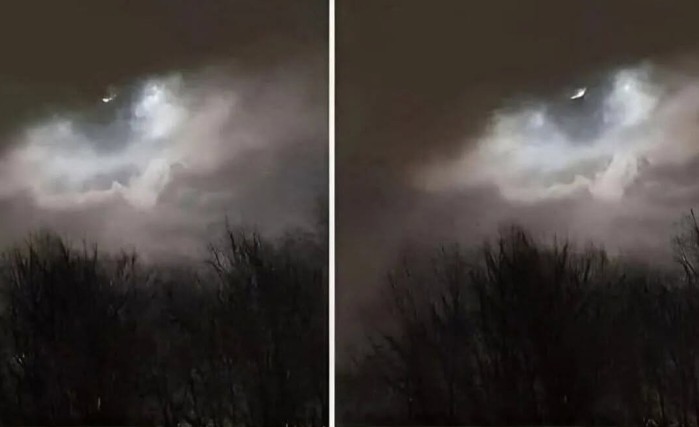
For centuries, unusual sights in the night sky have captured the imagination of people around the world. From comets and eclipses to rare atmospheric events, mysterious celestial phenomena often inspire curiosity, excitement, and sometimes concern. Recently, a series of photographs showing an unusual glowing formation emerging through dark clouds attracted widespread attention across social media, with many viewers struggling to explain what they were seeing.
The images appeared to show a bright object illuminating the clouds from above, creating a dramatic shape that some described as an eye, a portal, or even a supernatural sign. As the photographs spread online, countless theories emerged, ranging from scientific explanations to more imaginative interpretations.
Why Unusual Sky Events Capture Attention
Humans have always looked to the sky for answers. Long before modern science, people often interpreted strange celestial events as messages, warnings, or signs of significant change. Even today, unusual cloud formations or unexpected lights can quickly become viral topics because they trigger both emotional and intellectual responses.
When something appears unfamiliar, the brain naturally tries to identify patterns and meanings. This tendency explains why different viewers often see completely different things in the same image. Some might notice a face, while others see an animal, a symbol, or a natural phenomenon.
Psychologists refer to this as pareidolia, the tendency to perceive recognizable patterns in random shapes and objects. It is one reason why unusual cloud formations frequently generate intense public interest.
Although mysterious photographs can appear extraordinary, experts often find that natural explanations account for many of these events. Reflections from city lights, moonlight passing through cloud layers, ice crystals in the atmosphere, and even distant aircraft can create stunning visual effects.
In some cases, weather conditions combine in unique ways to produce rare optical phenomena. Thin cloud layers may scatter light unevenly, creating shapes and glowing regions that appear almost unreal. Depending on viewing angle and atmospheric moisture, the same event can look dramatically different from one location to another.
Astronomers and meteorologists frequently encourage people to examine environmental conditions before assuming an unusual event has an extraordinary cause.
In previous generations, unusual sightings were typically discussed within local communities. Today, however, a single photograph can reach millions of viewers within hours.
This instant exposure allows people from different backgrounds to contribute ideas and observations. While this can lead to valuable discussions, it can also encourage speculation and misinformation. A dramatic image shared without context often inspires theories that spread much faster than verified explanations.
Experts recommend approaching viral images with both curiosity and critical thinking. The most fascinating discoveries often emerge when people combine open-mindedness with careful investigation.
Wonder Still Has a Place
Even when science provides an explanation, unusual sky events retain their ability to inspire awe. The atmosphere, the moon, and the stars interact in countless ways that most people rarely notice during daily life.
Moments like these remind us that the natural world is filled with beauty and complexity. They encourage people to step outside, look upward, and appreciate the remarkable phenomena that occur above us every day.
Whether the glowing formation was caused by moonlight, atmospheric conditions, or another natural phenomenon, its impact was undeniable. The images sparked conversations, inspired theories, and encouraged people to pay closer attention to the world around them.
In an age dominated by screens and constant distractions, perhaps the greatest lesson is simple: sometimes the most captivating mysteries are found by looking up at the sky and allowing ourselves to wonder.